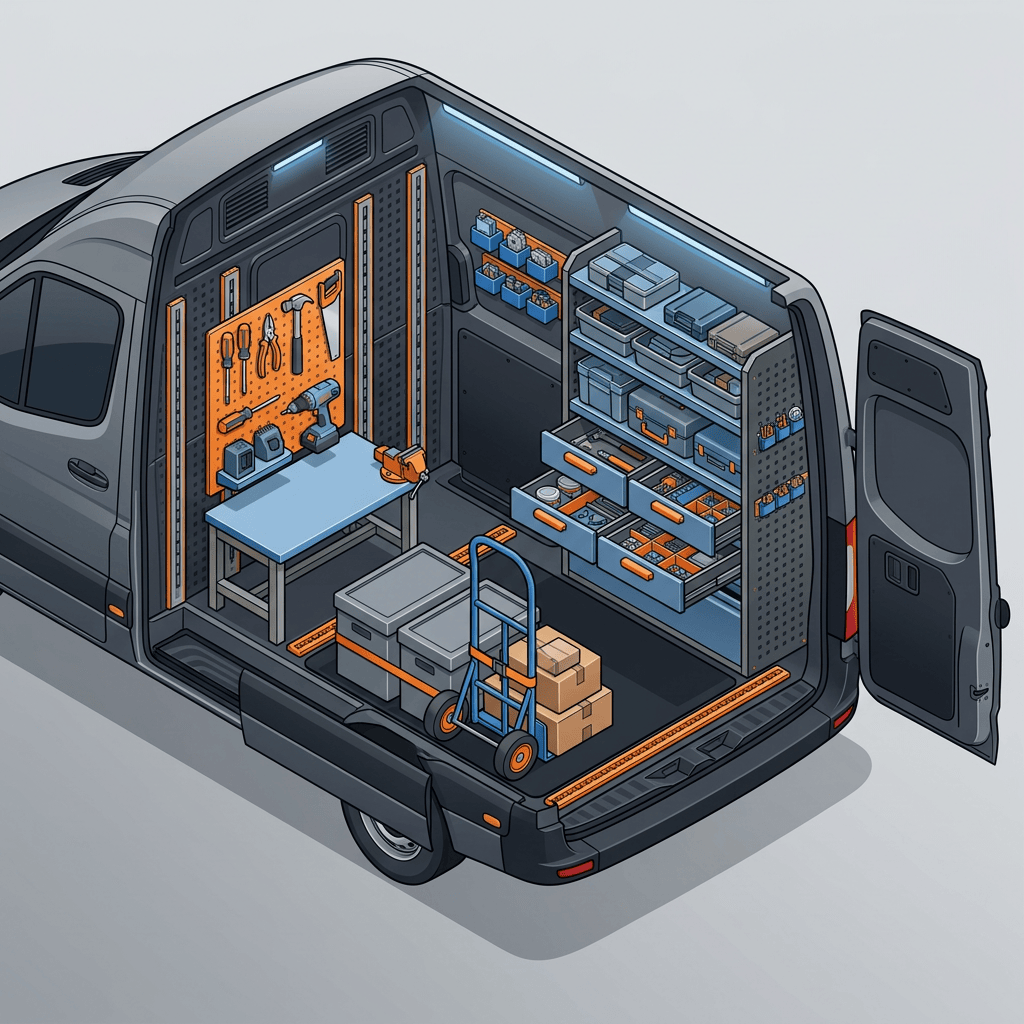
If you run an HVAC company, a plumbing shop, a solar crew, a delivery route, or a mobile detailing business in Las Vegas, your van is your office, your warehouse, and your rolling billboard. The Ford Transit cargo van comes in enough roof heights, lengths, and drivetrains that the hardest part is choosing.
This guide helps you pick the right new Transit configuration for your trade: roof height, length and wheelbase, AWD vs rear-wheel drive, gas engine choice, and when an E-Transit makes sense. It is not a tax guide, a used-van inspection checklist, or an upfit-process walkthrough. We will not quote prices, payments, incentives, or inventory counts. Specs depend on configuration and model year. Confirm them on the window sticker and with the store for the specific van. See dealer for details.
Team Ford Lincoln Las Vegas, 5445 Drexel Road: 12× President’s Award, 19× Partners in Quality, 8× Triple Crown.
Start on the money pages:
- New Ford Transit Cargo Van inventory
- Transit Cargo Van research page
- New E-Transit Cargo Van inventory
- All new inventory and contact us
The Transit lineup at a glance
According to Ford’s Transit page (checked October 6, 2026, where Ford now shows the 2027 lineup), the Transit family includes the Transit Cargo Van, the Transit Passenger Van (XL and XLT), and the all-electric E-Transit Cargo Van. This guide focuses on the two cargo vans. Model years on our lot can vary, so check the VDP.
| Ford Transit Cargo Van spec (per Ford.com) | What Ford lists |
|---|---|
| Roof heights | Low (about 82.7″–82.9″), Medium (about 99.8″–101.3″), High (about 109.1″–110″) |
| Lengths | Regular (217.8″), Long (235.5″), Extended (263.9″) |
| Wheelbases | 130″ or 148″ |
| Max cargo volume | 487.3 cu ft behind the first row (High Roof, Extended Length) |
| Engines | 3.5L PFDi V6 or 3.5L EcoBoost V6 |
| Drive | Rear-wheel drive; available Intelligent All-Wheel Drive |
| Fuel tank | 25 gallons; available 31-gallon tank |
Depends on configuration. Heights, lengths, volume, and payload change with roof, length, series, drivetrain, and equipment. Ford says Transit payload “varies depending on vehicle configuration,” so use the door-jamb label and window sticker on the exact van, not a brochure maximum.
Step 1: Pick the roof height
Roof height is the biggest decision, because it decides how you work inside the van and where you can park it.
- Low Roof: Best when the van has to fit parking structures, residential garages, or low clearance at job sites, or when a roof rack carries most of the long stuff. You won’t stand up inside.
- Medium Roof: A middle ground. More interior height for shelving and bins, while staying lower than a High Roof.
- High Roof: Built for working inside. Ford’s Transit page pitches the van’s vertical capability as room to “stand, work, and haul tall items with ease,” and the High Roof is where that applies most. It is the usual pick for stand-up shelving workflows and parcel routes.
Las Vegas reality check: Many Strip-area and hospital parking structures, older apartment complexes, and HOA garages post clearance limits. Measure your regular stops before you order, and remember that a ladder rack adds height on top of the roof.
Step 2: Pick the length and wheelbase
- Regular length (130″ wheelbase): Easiest to maneuver in tight cul-de-sacs, older Las Vegas neighborhoods, and crowded supply-house lots.
- Long length (148″ wheelbase): More floor for shelving down both sides, still manageable for most routes.
- Extended length (148″ wheelbase with a longer body): Maximum cargo floor. Ford’s largest cargo volume figure comes from the High Roof, Extended Length configuration.
Ask yourself: what is the longest item you carry every week (pipe, conduit, rails, ladders), and does it ride inside or on the roof?
Step 3: Decide on AWD vs rear-wheel drive
Las Vegas doesn’t see much snow, but plenty of work happens off pavement: graded dirt at new subdivisions, desert solar sites, and winter service calls up to Mount Charleston or Lee Canyon.
- Rear-wheel drive is the standard setup and fits most paved, in-town routes.
- Available Intelligent All-Wheel Drive helps with traction on loose or slick surfaces. Ford says it is integrated so it doesn’t raise the load floor or seat height, which matters for shelving and for crews climbing in and out all day.
Step 4: Choose your powertrain: gas or E-Transit
Gas Transit. Ford lists two 3.5L V6 choices: the 3.5L PFDi V6 and the available 3.5L EcoBoost V6. Talk with us about which fits your typical load, highway miles, and grades (like the climb out toward Henderson or up to Summerlin job sites).
E-Transit. Ford lists the E-Transit Cargo Van in three roof heights and Long or Extended lengths on the 148″ wheelbase, with a maximum payload of up to 3,322 lbs and range of up to 166 miles on a charge, per Ford.com. Real-world range depends on configuration, payload, temperature, and A/C use, which matters in a Las Vegas summer. E-Transit often fits best on:
- predictable daily routes that return to the shop every night
- businesses that can install depot or home charging (see our EV charging page)
- crews that can use available Pro Power Onboard (Ford lists an available 2.4 kW system on E-Transit) to run tools at the job site
Federal tax credit status: The federal Qualified Commercial Clean Vehicle Credit (45W) is not available for vehicles acquired after September 30, 2025, according to the IRS. Please don’t plan an E-Transit purchase around that credit. For any other tax questions, talk with your CPA.
Pick by trade: a starting point
| Trade | Common starting configuration | Why |
|---|---|---|
| HVAC | Medium or High Roof, Long length | Room for shelving, parts bins, and tall equipment; roof rack for ladders |
| Plumbing | High Roof, Long or Extended | Stand-up workflow, pipe storage down the length, drawer and bin units |
| Solar installers | Low or Medium Roof with a rack, Long or Extended; consider AWD | Rails and ladders ride up top; garage clearance stays manageable; dirt access on desert sites |
| Delivery / parcel | High Roof, Extended | Maximum cargo volume and stand-up loading for multi-stop routes; E-Transit worth a look for fixed routes |
| Mobile detailing | Medium or High Roof, Long | Room for water tank, pressure washer, and supplies; watch payload, because a full water tank is heavy |
These are starting points, not rules. Your tools, crew size, routes, and parking decide the final build.
Step 5: Order it upfit-ready
You don’t need to plan the whole build today, but a few factory choices make upfitting easier later:
- Shelving and trade packages. Ford lists available Shelving and Vocational/Trade Packages on the Transit Cargo Van.
- Onboard power. Ford lists Pro Power Onboard (400 W) on the gas Cargo Van, handy for charging tool batteries between calls.
- Fuel range. The available 31-gallon tank means fewer fuel stops for long-route vans.
- Partition and cab comfort. In Las Vegas heat, ask about a cargo partition and confirm the A/C setup for your crew.
- Telematics. Ford lists Ford Pro Telematics on the Cargo Van for fleet tracking (check current subscription terms).
Bring your upfitter’s requirements to the conversation before you choose a van, so the roof, length, and options match the build.
Shop a Transit at Team Ford
- Write down your trade, crew size, longest item, typical load, and the lowest clearance on your routes.
- Open new Transit Cargo Van inventory or new E-Transit inventory and shortlist vans by roof and length.
- Compare configurations on the Transit Cargo Van research page.
- Ask us for the window sticker and door-label photos on each van.
- Contact us or visit 5445 Drexel Road. Buying more than one? See our fleet sales guide for Las Vegas businesses.
Frequently Asked Questions
What roof heights does the Ford Transit cargo van come in?
Ford lists three: Low (about 82.7″–82.9″), Medium (about 99.8″–101.3″), and High (about 109.1″–110″), depending on configuration. Low Roof fits more parking structures; High Roof lets most people stand and work inside.
What lengths does the Transit cargo van come in?
Ford lists Regular (217.8″), Long (235.5″), and Extended (263.9″) lengths on 130″ or 148″ wheelbases. Regular is easiest to maneuver; Extended has the most cargo floor.
Is the Ford Transit available with AWD?
Yes. Ford offers available Intelligent All-Wheel Drive and says it doesn’t raise the load floor or seat height. Rear-wheel drive is the standard setup.
Can I still get the federal tax credit on an E-Transit?
No. According to the IRS, the Qualified Commercial Clean Vehicle Credit (45W) is not available for vehicles acquired after September 30, 2025. Talk with your CPA about any other tax questions.
How far can an E-Transit go on a charge?
Ford lists range of up to 166 miles on a charge. Real-world range depends on configuration, payload, temperature, and A/C use, so plan around your actual daily route.
Will this post list Transit prices or payments?
No. No prices, payments, rates, incentives, or inventory counts. Browse new Transit Cargo Van inventory and confirm numbers at 5445 Drexel Road. See dealer for details.
Conclusion + next steps
The right Ford Transit cargo van in Las Vegas is the one built around your trade: a roof height that fits how you work and where you park, a length that fits what you carry, AWD if your jobs go off pavement, and gas or E-Transit based on your routes.
- Shop Transit vans: New Transit Cargo Van · New E-Transit Cargo Van
- Research configurations: Transit Cargo Van research · All new inventory
- Contact or visit Team Ford Las Vegas at 5445 Drexel Road: contactus
Specs depend on configuration and model year. Check the window sticker and door label for the specific van, and confirm availability, equipment, pricing, and current offers with the store. See dealer for details.


Leave a comment