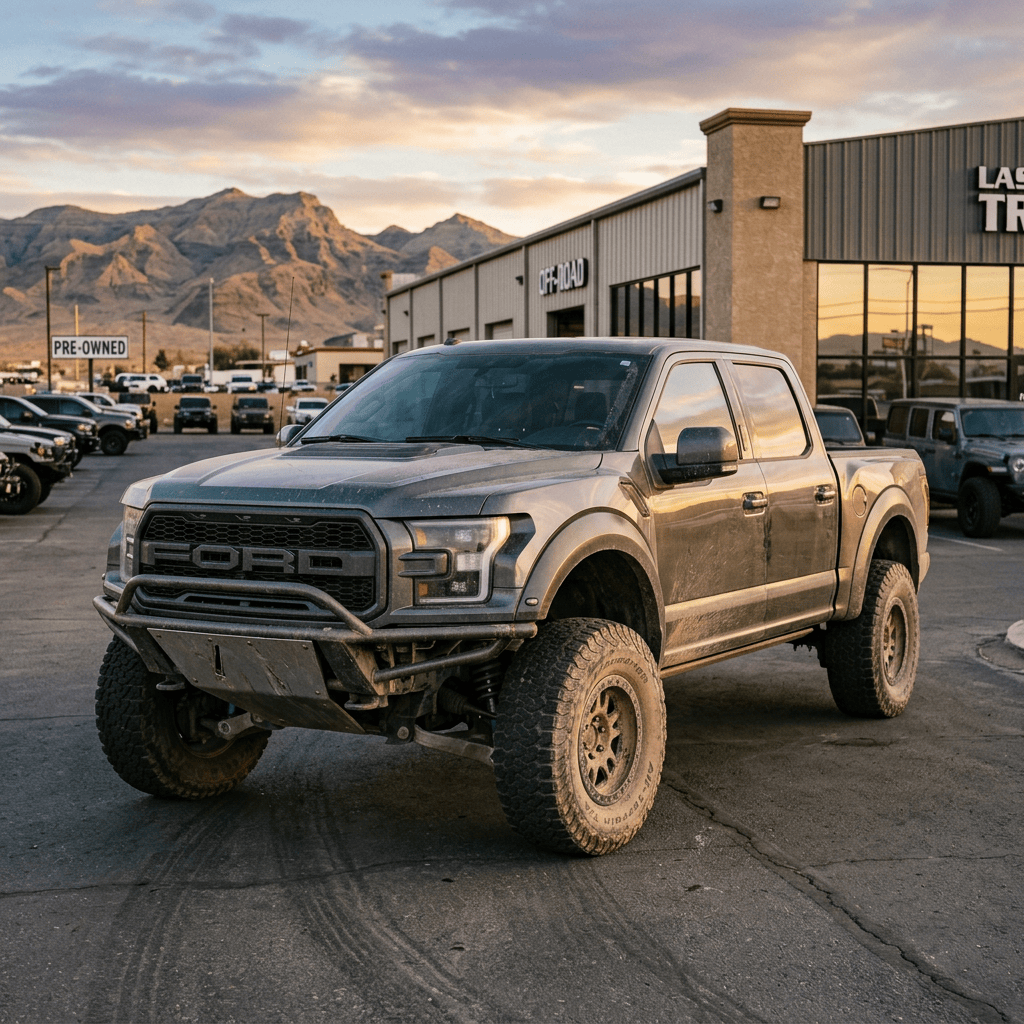
A used Ford Raptor in Las Vegas is the dream truck for a lot of desert drivers. It is also the used Ford most likely to have been driven exactly the way it was designed to be driven: fast, off-road, and sometimes airborne. Two Raptors with similar miles can be completely different trucks.
This guide covers all three Raptor nameplates Ford currently builds, the F-150 Raptor (including Raptor R), the Bronco Raptor, and the Ranger Raptor, and gives you a walk-around checklist built for Southern Nevada: suspension and shocks, frame and jump-damage clues, wheels and tires, skid plates, modifications, service records, and certification questions. We will not quote prices, values, payments, or inventory counts. Every used Raptor is VIN-specific. Confirm equipment, condition, and history on the vehicle detail page (VDP) and with the store. See dealer for details.
Team Ford Lincoln Las Vegas, 5445 Drexel Road: 12× President’s Award, 19× Partners in Quality, 8× Triple Crown.
Start on the money pages:
- Used Ford F-150 inventory (F-150 Raptors live here)
- Used trucks in Las Vegas and certified pre-owned F-150s
- Used Ford Bronco inventory and used Ford Ranger inventory
- Contact us (ask for underbody photos, history, or a walk-around)
Which used Raptor fits your Las Vegas life?
According to Ford’s Raptor lineup page (checked October 6, 2026), Ford offers Raptor models in the F-150 (Raptor and the more powerful Raptor R), the Ranger, and the Bronco.
| Raptor | Often a fit when… | Used-market notes |
|---|---|---|
| F-150 Raptor / Raptor R | You want full-size room for family and gear plus desert-runner manners | Ford lists three generations: 2010–2014, 2017–2020, and 2021–present. Know which one you are looking at, because suspension and powertrains changed between them. |
| Bronco Raptor | You want an SUV that can run Mojave washes and still carry the family | Built on the current-generation Bronco, so roof, door, and seal checks matter too. |
| Ranger Raptor | You want Raptor capability in a midsize truck that fits tighter garages and trails | Ford lists its first generation in the U.S. starting in 2024, so used examples are late-model. |
Still weighing new? Compare new F-150 inventory, and see why desert drivers pick the F-150 Raptor in our Raptor buyer’s post and our Raptor vs Silverado ZR2 comparison.
Step 1: Suspension and shocks
The suspension is the heart of any Raptor, and it is where hard desert miles show up first.
- Shock bodies and seals. Look for oil weeping or wet, dirt-caked shock bodies, dented reservoirs, and torn boots. A little dust is normal; fresh oil is not.
- Bushings and mounts. Check control-arm bushings, shock mounts, and bump stops for cracks, crushing, or heavy wear.
- Electronic dampers (where equipped). Many Raptors use FOX Live Valve shocks, which Ford says adjust damping electronically in real time. On the test drive, confirm there are no suspension or drive-mode warning messages.
- Ride and alignment. The truck should track straight, the steering wheel should sit centered, and there should be no clunks over bumps or at full lock.
- Ask what has been serviced. Shocks are wear items on a truck driven hard. Ask whether any have been rebuilt or replaced, by whom, and with what parts.
Step 2: Frame and jump-damage clues
Raptors are tough, but repeated big hits can leave marks. Put the truck on a lift if the store allows it, or bring a good flashlight.
- Frame rails and crossmembers. Look for kinks, ripples, fresh welds, or bent sections, especially near the front frame horns, shock towers, and rear spring or suspension mounts.
- Bump-stop contact. Heavily flattened or damaged bump stops can mean repeated full-compression landings.
- Body gaps. Uneven gaps between the cab and bed, or doors that don’t close cleanly, can hint at frame stress or past repairs.
- Steering and axles. Check tie rods, the steering linkage, CV boots, and differential housings for bends, tears, leaks, or dents.
- Water and sand clues. Silt packed in frame rails, sand in odd places, or moisture in lamps all deserve questions.
A Raptor with honest scuffs isn’t a bad buy. You want wear that matches the story, and an inspection report that addresses it. A bent frame component is a reason to walk away or get a second opinion.
Step 3: Wheels and tires
- Date codes on every tire, including the spare. Las Vegas heat ages rubber fast, regardless of tread depth.
- Even wear. Cupping or one-sided wear points to alignment problems after trail hits.
- Sidewalls. Look for cuts, chunks, and plugs from sharp desert rock.
- Wheels. Check for cracked or bent lips and heavy rock rash. Ford offers beadlock-capable wheels on Raptor models; if equipped, inspect the rings and hardware and ask whether they have been used for low-pressure off-roading.
- Size changes. If the truck runs a different tire size than it left the factory with, ask whether settings were recalibrated, and confirm the tire’s load rating suits the vehicle.
For tire thinking once it is yours, our off-road tire guide for Bronco owners applies to Bronco Raptor owners too.
Step 4: Skid plates, rock rails, and the underbody
Ford says Raptor models come with factory high-strength steel skid plates and reinforced rock rails. That armor is designed to take hits, so use it as a history book.
- Skid plates: Light scrapes are expected. Deep gouges, bent edges, missing bolts, or plates pushed up into components are not.
- Rock rails and rockers: Dents tell you the truck has been on real rock, not just graded dirt.
- Exhaust, transfer case, and differentials: Look for dents, scrapes, and leaks.
- Front bumper and lower valance: Look for cracks, missing pieces, or mismatched paint from previous repairs.
Step 5: Mods and tunes: ask before you admire
Raptor owners love upgrades. Mods aren’t a dealbreaker; undocumented mods can be.
- Receipts and installers. Know what was installed, by whom, and when.
- Engine tunes. Ask directly whether the powertrain has ever been tuned, and whether it has been returned to factory calibration.
- Suspension changes. Aftermarket shocks, lifts, or leveling kits change ride, alignment, and how parts wear.
- Wiring. Light bars and accessories should be cleanly wired and fused, using factory auxiliary switches where equipped.
- Bumpers, winches, and exhaust. Confirm solid mounting and proper function.
- Warranty questions. Whether a modification affects coverage depends on the part and the failure. Ask the store how it applies to that VIN rather than assuming either way.
Step 6: Service records and 4×4 systems
- Records. Ask for oil-change history, plus differential and transfer-case fluid service, especially after water crossings or dusty use. Ask whether it was maintained on the owner’s manual schedule for severe or special operating conditions.
- Open recalls and service actions. Ask the store to check recall and field-service status on the VIN.
- 4×4 and drive modes. Shift through the available 4×4 modes and drive modes (as equipped) and confirm each engages cleanly without warning lights.
- Locking differentials (where equipped). Engage them and confirm the indicators respond.
- A/C at idle. Let it run at least 10–15 minutes while parked. In a Las Vegas summer, this is non-negotiable.
For hot-weather care after you buy, see our summer maintenance tips for Las Vegas heat. Shopping a non-Raptor F-150 instead? Our used F-150 buying guide covers cab, bed, and engine choices.
CPO vs non-certified used Raptor: questions to ask
| Option | Often a fit when… | What to ask |
|---|---|---|
| Ford Blue Advantage certified Raptor | You want a documented inspection and certified coverage on a high-performance truck | Which tier (Gold or Blue)? Can I see the inspection checklist? What are the warranty terms on this VIN? |
| Non-certified used Raptor | You found the right generation, color, and equipment and can verify condition yourself | Can I see the history report, inspection and recon notes, tire dates, and recall status? |
| Modified Raptor | The mods match what you would have added anyway | Do the mods affect certification eligibility? How does coverage apply to this VIN? Can I see receipts? |
Not every used Raptor qualifies for certification. Age, mileage, condition, and modifications can all affect eligibility, so ask. Browse certified F-150s and read our Ford Blue Advantage guide.
How to shop a used Raptor at Team Ford (same week)
- Open used F-150, used Bronco, and used Ranger inventory, or the used trucks page. Raptor-trim units come and go, so shortlist two stock numbers.
- Ask for underbody and shock photos, tire date codes, the history report, recall status, and the inspection notes on both.
- Ask about mods, tunes, and any factory parts that were removed.
- If you are trading, start at Value Your Trade.
- Contact us or visit 5445 Drexel Road for a test drive that includes 4×4 engagement, drive modes, and A/C at idle.
- Confirm every number, including price and terms, at the desk on that VIN.
Own a Bronco Raptor after the sale? Ford runs Bronco Off-Roadeo Nevada on Mt. Potosi, just outside Las Vegas, for Bronco Raptor owners (per Ford.com; check Ford for current eligibility).
Frequently Asked Questions
What should I check first on a used Ford Raptor in Las Vegas?
Start with the suspension and underbody: shock bodies and seals, bushings and mounts, bump stops, frame rails, skid plates, and rock rails. Then check tire date codes, wheels, mods or tunes, and service records. Browse used F-150s and ask for the inspection notes on the VIN.
How can I tell if a used Raptor has been jumped or abused off-road?
Look for flattened or damaged bump stops, cracked shock mounts, kinks or fresh welds on the frame, uneven body gaps, and bent steering parts. Off-road scuffs alone aren’t a red flag. Wear that doesn’t match the story is.
Which used Raptor is right for me: F-150, Bronco, or Ranger?
The F-150 Raptor is the full-size option for room and desert-runner manners, the Bronco Raptor is the SUV, and the Ranger Raptor is the midsize truck. Ford lists the Ranger Raptor’s U.S. first generation starting in 2024, so used Ranger Raptors are late-model.
Can a used Raptor be certified pre-owned?
Some can. Eligibility depends on age, mileage, condition, and modifications. Ask whether the VIN qualifies, which Ford Blue Advantage tier it carries, and what coverage applies. Check certified F-150s.
Do aftermarket parts or tunes void a used Raptor’s warranty?
It depends on the part and the failure. Ask the store to explain how coverage applies to that specific VIN, ask whether the truck has ever been tuned, and get receipts for any installed parts.
Will this post list used Raptor prices or values?
No. This guide does not list prices, values, payments, or inventory counts. Check live listings and confirm numbers with the store at 5445 Drexel Road. See dealer for details.
Conclusion + next steps
A used Ford Raptor in Las Vegas can be a great buy when you check what the desert left behind: shocks and suspension, the frame, wheels and tires, skid plates, mods and tunes, and the service records. Shop by VIN, not by photos.
- Browse used Raptor-capable inventory: Used F-150 · Used trucks · Certified F-150
- Check the other Raptors: Used Bronco · Used Ranger
- Contact or visit Team Ford Las Vegas at 5445 Drexel Road: contactus
Confirm availability, condition, equipment, pricing, and current offers with the store. See dealer for details.


Leave a comment