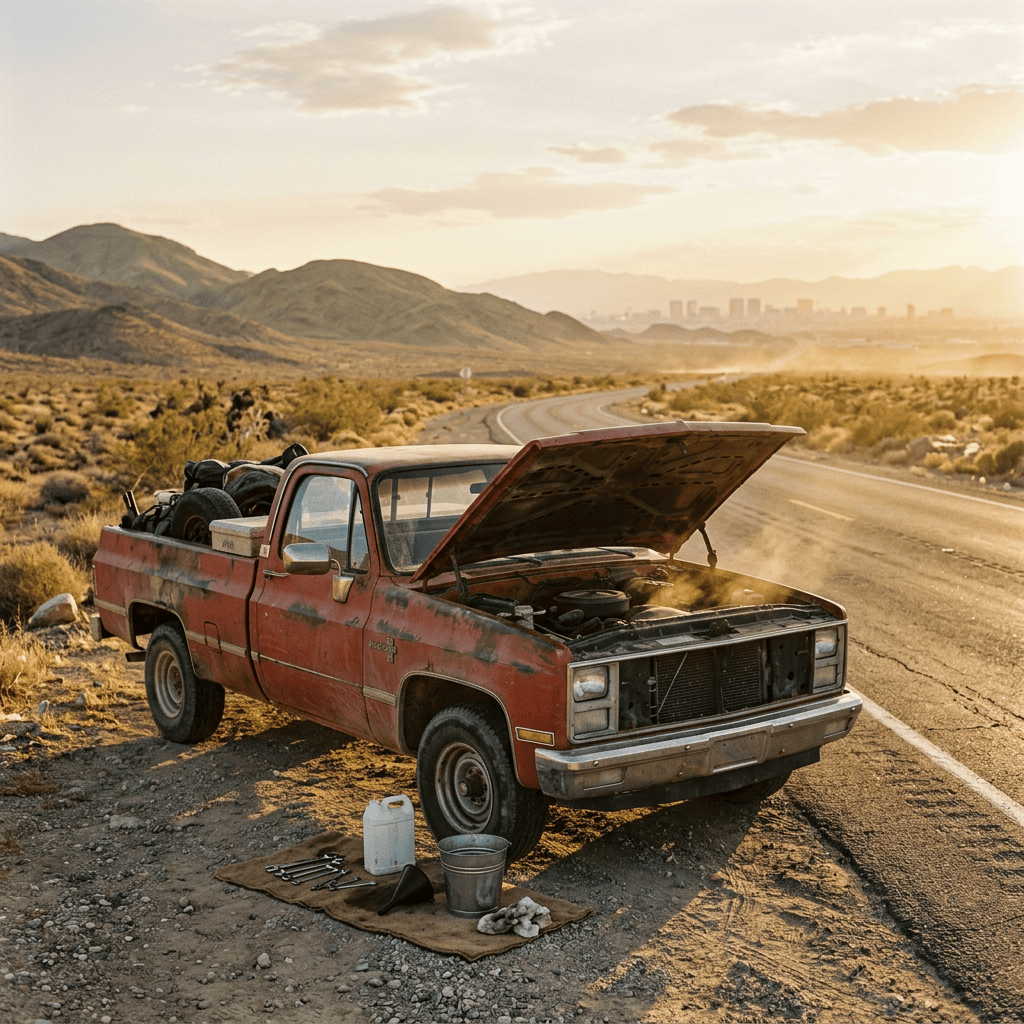
Short answer: A high-mileage used F-150 (think 100,000+ miles) can still be a solid Las Vegas truck if the records, cooling and transmission behavior, 4×4 system, towing history, and frame/underbody check out — and if you finish with an open-recall VIN lookup. Ford’s own owner’s manuals set oil-change timing with an Intelligent Oil-Life Monitor and call for extra maintenance when a truck primarily tows, idles a lot, runs dusty roads or works off-road. We don’t quote prices or call any engine “good” or “bad” here. Condition varies by VIN — see dealer for details.
This checklist uses Ford’s 2023 F-150 Owner’s Manual (fordservicecontent.com) and a current NHTSA recall record, all checked October 15, 2026. Always confirm maintenance on the specific truck and recalls on that VIN.
Team Ford Lincoln Las Vegas, 5445 Drexel Road: 12× President’s Award, 19× Partners in Quality, 8× Triple Crown.
Start here:
- Used F-150 inventory
- Bargain inventory
- Used F-150 buying guide (cab, bed, engine)
- Used vs new F-150
- Value your trade · Contact us
Who this checklist is for
Use this post when you’re already past the cab/bed/engine choice and the odometer is in six figures. Pair it with our live used F-150 buying guide for configuration, and used vs new F-150 if you’re still deciding new vs used.
| Checkpoint | Why it matters in Las Vegas |
|---|---|
| Maintenance records | Heat, dust and towing often land a truck in Ford’s harder “special operating conditions” |
| Cooling system | Triple-digit summers and stop-and-go arterials work the cooling stack |
| Transmission behavior | Hot fluid and heavy loads show up on a thorough test drive |
| 4×4 / transfer case | Desert trails and storm days punish neglected 4WD hardware |
| Towing history | Hitch, wiring and rear suspension tell the real story |
| Frame / underbody | Dirt, prior off-road use and underbody corrosion hide above the pavement |
| Open recalls | Finish every used buy with a VIN search |
1. Records first (before you fall in love with the truck)
Ask for a folder or printout that shows:
- Oil and filter changes with dates and mileage
- Any transmission, coolant, transfer case or axle service notes
- Brake, tire and alignment work
- Prior recall completion paperwork if any
Ford’s 2023 F-150 manual tells owners to keep all receipts for completed maintenance with the vehicle. Gaps aren’t automatic deal-breakers, but they change how hard you inspect and whether you budget a catch-up service.
What Ford’s Intelligent Oil-Life Monitor actually says
Ford’s 2023 F-150 Owner’s Manual:
- The Intelligent Oil-Life Monitor displays an oil-change message at the proper interval.
- That interval may be up to one year or 10,000 miles (hybrid vehicles could exceed 10,000 miles).
- Change the oil within two weeks or 500 miles of the message.
- Reset the monitor after every oil change.
- If the display resets early or fails, Ford says to change oil at six months or 5,000 miles from the last change.
- Never exceed one year or 10,000 miles between oil changes.
Short trips that don’t warm the engine, extended idling, and low-speed driving for long periods can dilute the oil — all common in Las Vegas traffic and jobsite idle.
2. Special operating conditions — Las Vegas trucks often live here
Ford’s Special Operating Conditions Scheduled Maintenance chapter says that if you operate the vehicle primarily in certain conditions, you need extra maintenance. Occasional use doesn’t always trigger the extras — ask the seller how the truck actually spent its miles.
| Condition (Ford wording, condensed) | Extra maintenance Ford lists |
|---|---|
| Towing a trailer or using a car-top carrier | Follow the oil-life monitor; inspect/lubricate U-joints frequently; see axle items under Exceptions; replace spark plugs every 60,000 miles |
| Extensive idling or low-speed driving for long distances (delivery, taxi, patrol, livery) / short trips that dilute oil | Follow the oil-life monitor; replace engine air filter frequently as required; spark plugs every 60,000 miles |
| Dusty or sandy conditions (unpaved or dusty roads) | Replace engine air filter frequently; every 5,000 miles inspect wheels/related components and rotate tires; every 5,000 miles or six months change oil and filter (and reset the reminder) |
| Off-road operation | Inspect steering linkage, ball joints and U-joints frequently; replace engine air filter as required; every 5,000 miles or six months change oil/filter and inspect wheels/tires |
Axle and transfer case (Exceptions): On four-wheel-drive vehicles, Ford says axle(s) and transfer case fluid changes or level checks are not required unless a leak is suspected or the assembly has been submerged in water. Contact an authorized dealer for service. That is not permission to ignore leaks — it’s Ford’s interval rule. Ask about water crossings and look for seepage anyway.
For Southern Nevada, dusty roads, idle time in heat, and weekend towing are the usual reasons a high-mileage F-150 needs a harder look than a garage queen with the same odometer.
3. Cooling system and heat checks
Ford’s owner checks for the 2023 F-150 include:
- Every month: engine oil level; lights; tire wear/pressure (including spare); washer fluid
- Every six months: battery connections; body/door drain holes; cooling system fluid level and coolant strength; door weatherstrips; hinges/latches/locks; parking brake; seatbelts; warning lamps; wipers
On a high-mileage candidate in Las Vegas:
- Look at coolant level and color with a cold engine (don’t open a hot cap).
- Watch the engine coolant temperature gauge on a long hot idle and a highway pull.
- Ask whether the thermostat, water pump, radiator, hoses or fans have been replaced — and keep the receipts.
- Include cooling in any pre-purchase inspection.
Our live summer heat maintenance tips explain why cooling and cabin comfort work harder here.
4. Transmission behavior on the test drive
We’re not diagnosing a transmission from a blog post. What you can do on a thorough drive:
- Cold start: listen for unusual noises; note whether engagement into Drive/Reverse is clean.
- Hot drive: after 20–30 minutes in traffic, check for flare, harsh shifts, delayed engagement or a transmission-temperature warning.
- Tow/Haul mode (if equipped): make sure it engages and the truck responds as expected.
- Ask when transmission fluid was last serviced. Ford’s multi-point inspection list includes checking fluid levels (brake, coolant recovery, automatic transmission, washer) at scheduled maintenance visits.
If anything feels off, stop and get a shop diagnosis before you buy — especially on a six-figure odometer.
5. 4×4 system checks
On 4×4 trucks:
- Cycle 2H / 4H / 4L (as equipped) on an appropriate surface per the owner’s manual.
- Listen for binding, grinding or warning messages.
- Look under the truck for transfer case or axle seepage.
- Ask whether the truck saw deep water, beach sand or frequent trail use.
Remember Ford’s Exception: axle/transfer case fluid changes aren’t on a fixed mileage schedule unless there’s a leak or submersion — so history and a visual leak check matter more than hunting for a stamped “60k transfer case service” on every truck.
6. Towing history and hitch wear
If the truck towed (boats, toys, equipment):
- Inspect the hitch receiver for rust, elongated pin holes, cracks or a bent tongue.
- Test trailer wiring and any brake controller.
- Look at rear tires, springs/air bags and bed mounts for sag or cracks.
- Ask what was towed and how often — a lake boat a few weekends a year is different from weekly equipment hauling.
Ford’s towing special-maintenance list is a reminder that primary tow use is supposed to bring extra inspections (U-joints, axle attention under Exceptions, spark plugs at 60k). Missing records aren’t proof of abuse, but they raise the bar for your inspection.
7. Frame, underbody and bed
On a lift or with a bright flashlight:
- Frame rails and crossmembers: look for fresh undercoating hiding damage, bent sections, or severe rust (less common in the desert than in salt states, but rock rash and prior wrecks still show).
- Fuel tank straps and tank area: visual condition matters; also run the recall check below.
- Bed floor, stake pockets and spray-in liner cracks.
- Ford’s care chapter includes cleaning the underbody — packed mud and debris hold moisture against components after storm or trail use.
8. Open-recall check (do this on every VIN)
Before you buy, enter the 17-character VIN at NHTSA.gov/recalls and on Ford’s owner recall tools.
Example still relevant on 2026-10-15: Ford recall 26S69 (NHTSA 26V578000) covers certain 2023–2027 F-150 trucks where front fuel-tank strap T-slots may not have been properly inserted into the frame rail. NHTSA’s summary: the fuel tank may be improperly secured and leak fuel, or detach while driving. Remedy: dealers inspect and replace straps as needed, free of charge. Owner letters were mailed September 21, 2026; VINs became searchable on NHTSA beginning September 14, 2026. Ford customer service: 1-866-436-7332.
Ford’s Part 573 filing notes the affected population is tied to a production window and early-life exposure — model year alone does not tell you if a VIN is included. Always search the VIN. We quote no unit counts here.
We also drafted a full Ford recall how-to (WordPress draft). Until that post is live, use NHTSA/Ford directly, or schedule service at Team Ford and put the recall number in your notes.
Multi-point inspection: what Ford recommends at service visits
Ford’s 2023 F-150 manual recommends a multi-point inspection at every scheduled maintenance interval, including accessory drive belt(s), battery performance, engine air filter, radiator/cooler/heater/A/C hoses, exhaust, suspension leaks/damage, exterior lamps, steering/linkage, fluid levels, tires (including spare), oil/fluid leaks, windshield condition, half-shaft dust boots, and washer/wiper operation.
On a high-mileage purchase, asking Team Ford’s service team for that style of inspection — or bringing your own trusted inspector — is cheaper than guessing from a curb walkaround.
Frequently Asked Questions
Is a used F-150 with over 100,000 miles a bad idea?
Not automatically. Mileage is one input. Records, how the truck was used (towing, idling, dust, off-road), and a careful inspection matter more. This guide doesn’t rank engines or quote prices.
What maintenance schedule does Ford publish for F-150 oil changes?
Ford’s Intelligent Oil-Life Monitor sets the interval — up to one year or 10,000 miles in the 2023 manual (hybrids may exceed 10,000). Never exceed one year/10,000 miles. Change within two weeks or 500 miles of the message. Special conditions (dust, off-road, heavy idle, towing) add extra items.
What should I check on a high-mileage 4×4 F-150?
Cycle the 4×4 modes on a safe surface, listen for noises or warnings, and inspect for transfer case or axle leaks. Per Ford’s Exceptions, axle/transfer case fluid service isn’t mileage-scheduled unless there’s a leak or water submersion — so visuals and history still matter.
How do I know if a used F-150 was used for towing?
Ask the seller, then verify: hitch wear, wiring, brake controller, rear tire/suspension wear, and any tow packages on the window sticker or build sheet. Primary tow use is one of Ford’s special operating conditions.
Are there open recalls on used F-150s?
Sometimes. Always check the VIN on NHTSA.gov. One current example is 26S69 / 26V578000 (fuel-tank straps on certain 2023–2027 F-150s), verified on NHTSA on October 15, 2026. Recall repairs are free at Ford dealers when a VIN is included.
Will you tell me what a high-mileage F-150 should cost?
No. No prices, payments or trade values in this post. Shop used F-150 inventory and bargain inventory, and ask us about a specific VIN.
Next steps at Team Ford Las Vegas
- Browse used F-150 inventory and bargain inventory.
- Bring this checklist to the lot; we’ll pull records and walk the truck with you.
- Run the VIN on NHTSA before you commit.
- Ask about Ford Protect options on eligible used units, and value your trade if you’re swapping out of another vehicle.
- Contact us or schedule service for inspection questions.
Team Ford Las Vegas · 5445 Drexel Road · See dealer for details. Every used vehicle is different.


Leave a Reply