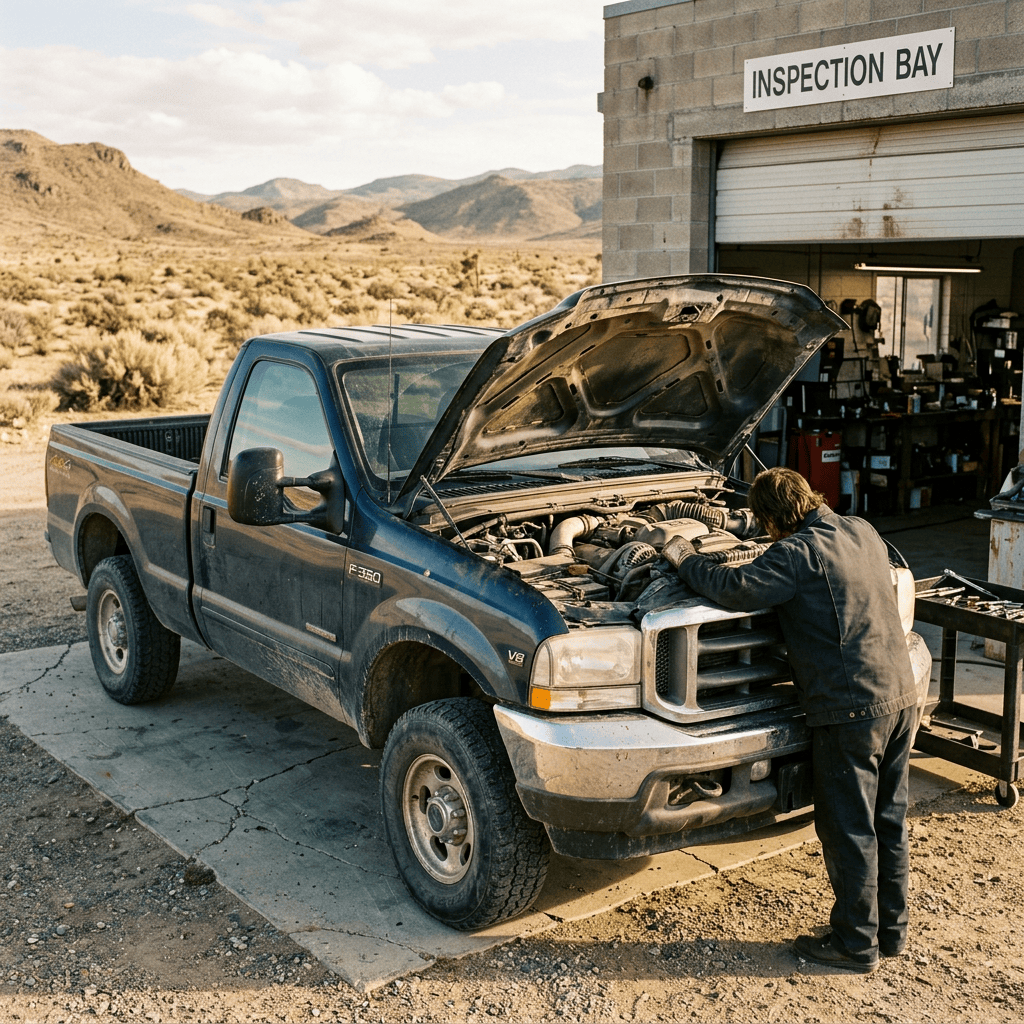
Short answer: A used 6.7L Power Stroke Super Duty can be a strong Las Vegas truck. Before you buy, verify these six things:
- Records for oil, both diesel fuel filters and the water separator
- A healthy diesel particulate filter (DPF), with no “service now” history
- A working diesel exhaust fluid (DEF) / SCR system, with no fault messages
- Towing history and hardware
- No signs of emissions tampering
- An open-recall VIN check
Ford’s own Super Duty owner’s manual sets those service items. It treats heat, dust, idling and towing as severe driving conditions, which describes plenty of Southern Nevada trucks. If a seller tells you the emissions equipment has been removed or disabled, walk away. No prices here. Every truck is different. See dealer for details.
This checklist uses Ford’s 2024 Super Duty Owner’s Manual (fordservicecontent.com), ford.com’s current Super Duty page and NHTSA recall records, all checked October 16, 2026. Intervals can differ by model year, so always confirm against that truck’s manual and VIN.
Team Ford Lincoln Las Vegas, 5445 Drexel Road: 12× President’s Award, 19× Partners in Quality, 8× Triple Crown.
Start here:
- Used F-250 Super Duty inventory
- Used F-350 Super Duty inventory
- Used trucks in Las Vegas
- Schedule service / pre-purchase questions · Contact us
The used 6.7L diesel checklist at a glance
| Checkpoint | What to ask or look for | Ford’s reason (owner’s manual) |
|---|---|---|
| Records | Oil changes, engine-mounted and frame-mounted fuel filters, air inlet foam filter, belts | Diesel-specific scheduled maintenance |
| Duty cycle | Short trips, idling, dust, heat, heavy towing? | Ford lists these as severe driving conditions |
| DPF | Any “Exhaust filter over limit, service now” history? DPF ever replaced? | An overfilled DPF can disable regeneration and cause damage the warranty may not cover |
| DEF / SCR | Fault messages, speed-limit events, DEF quality | Empty or contaminated DEF limits speed, then idle only |
| Water in fuel | How often the water separator was drained | Water past the separator can damage fuel injection equipment |
| Towing | Hitch wear, exhaust brake, rear axle service | Hot-weather towing changes Ford’s rear axle fluid interval |
| Tampering | Tuners, missing DEF parts, emissions “delete” talk | Ford: laws prohibit removing or disabling emission controls |
| Recalls | VIN check on NHTSA | Diesel fuel-pump recalls exist on certain 2020–2022 trucks |
1. Confirm the truck, then pull that truck’s manual
Ford’s current Super Duty page lists the 6.7L High-Output Power Stroke V8 Turbo Diesel as available on all models (standard on F-450). Used trucks cover many model years, and equipment and service intervals change over time. Before you compare notes:
- Confirm the engine on the build data / window sticker or the vehicle detail page.
- Find the owner’s manual for that model year on Ford’s owner site, and use it as the source of truth.
This post quotes Ford’s 2024 Super Duty manual as a reference point.
2. Records: the diesel items most sellers forget
From Ford’s 2024 Super Duty Scheduled Maintenance chart:
| Item (diesel) | Ford interval (2024 manual) |
|---|---|
| Engine oil and filter | When the Intelligent Oil-Life Monitor says so; Ford recommends changing within two weeks or 500 miles of the alert |
| Engine-mounted and frame-mounted fuel filters | Every 30,000 miles, or every 15,000 miles for diesel severe service. Also change them when a low fuel pressure message appears |
| Fuel and water separator | Drain at each oil-change interval if necessary or if the cluster tells you to |
| Engine air inlet foam filter | Every 50,000 miles (every 30,000 miles for diesel severe service) |
| Accessory drive belt(s) | Inspect at 90,000 miles; replace at 100,000 miles |
| Brake fluid | Every three years |
What to ask: “Can I see receipts for both fuel filters, not just oil changes?” Missing fuel-filter records aren’t automatic deal-breakers, but they’re the first thing to budget for.
3. Why Las Vegas trucks often count as “severe service”
Ford’s 2024 Super Duty manual says these count as severe driving conditions:
- Short trips of less than 5–10 miles
- Temperatures greatly below or above average
- Dusty conditions
- Idling more than recommended, such as in traffic
- Driving with a heavy load or while towing
Summer heat, desert dust, jobsite idling and weekend toy-hauling put many Southern Nevada diesels squarely on the severe side. Ask the seller how the truck was used, then check the records against the severe column.
4. Diesel particulate filter (DPF): questions that matter
Ford says the DPF traps exhaust particles and must clean itself periodically through passive, active and manual regeneration.
What Ford’s manual says to watch for:
- If the truck mostly ran short trips, frequent key-on/key-off cycles or lots of stop-and-go, Ford calls for occasional drives of at least 20 minutes at highway speeds, ideally holding 1,500–3,000 RPM, to help regeneration.
- Messages like “Exhaust filter overloaded, drive to clean” mean the filter is full. Ford says to drive above 30 mph when safe until the message clears.
- “Exhaust filter over limit, service now” means dealer service. Ford warns that ignoring it can lead to DPF damage the new-vehicle warranty may not cover.
- Ford also says that if the DPF fills beyond the regeneration threshold, the truck disables active and manual regeneration, which “could result in irreversible damage.”
- Ash note: some ash never burns off. Ford says the DPF may need replacement with a new or remanufactured part at approximately 250,000 miles, depending on conditions.
Las Vegas-specific: Ford warns not to park or idle over dry grass, dry leaves or other combustible materials during and after regeneration. That matters if the truck worked desert lots or brush-lined jobsites, and it’s worth knowing once you own it.
On the test drive: note any exhaust-filter messages, and ask whether the DPF has ever been serviced or replaced.
5. DEF and the SCR system: don’t ignore the blue cap
Ford’s SCR system injects diesel exhaust fluid to convert nitrogen oxides into nitrogen and water.
- Usage: Ford says DEF usage runs about 2–6% of fuel burned (roughly 2–6 gallons of DEF per 100 gallons of fuel), depending on payload/towing, driving style, altitude, humidity and temperature.
- Low DEF warnings start around 500 miles of DEF remaining. Ford notes that under heavy load the warning can appear with more than half a tank left.
- Empty or contaminated DEF: speed becomes limited (Ford cites 50 mph). If you don’t refill, the engine eventually enters idle-only mode.
- Only API-certified DEF. Ford says non-certified DEF can cause damage the warranty may not cover. Never dilute it.
- Vegas storage tip straight from Ford: store DEF out of direct sunlight at 23–68°F, and don’t store DEF bottles in the vehicle. A jug that baked in a truck bed all summer is a question worth asking about.
- Use only the correct blue vented DEF cap. Ford says the wrong cap or seal can damage the system.
What to ask: “Has this truck ever shown a DEF quality or system fault, or gone into speed-limit mode?”
6. Water in fuel and fuel quality
Ford’s 2024 manual says the diesel fuel conditioner module (water separator) should be drained whenever the warning light or message appears. Ford says the message comes on once water collects in the module, and that letting water go past that point “may cause fuel injection equipment damage.”
What to ask: “How often did the water-in-fuel message come on, and who drained it?” Frequent messages can point to fuel-source habits worth understanding.
7. Tuning and “delete” red flags: ask, then walk away if needed
Ford’s owner’s manual is direct: U.S. federal laws and certain state laws prohibit removing or rendering inoperative emission control system components. Ford also says:
- Tampering with emissions controls, including related sensors or the DEF system, can reduce engine power and turn on the service engine soon light.
- Tampering with or disabling the SCR system results in severe performance limits, including eventual speed limiting to 5 mph.
Red flags to ask about:
- An aftermarket tuner or handheld programmer in the console, or receipts for “tunes”
- Missing or bypassed DEF components, or a missing blue DEF cap
- Aftermarket exhaust where the factory DPF/SCR hardware should be
- A seller who says the truck “never does regens” or “doesn’t need DEF”
If the answers point to removed or disabled emissions equipment, walk away. This isn’t legal advice. It’s the simplest way to protect yourself. We also wrote a general guide to lifted and modified used trucks (WordPress draft), and it’ll be linked here once it’s live.
8. Towing history, exhaust brake and the rear axle
Many used diesels towed heavy.
- Hitch and wiring: look for elongated receiver pin holes, cracks, worn wiring and a tired brake controller.
- Exhaust brake (if equipped): ford.com describes the 6.7L’s diesel engine exhaust braking as restricting exhaust flow to create back pressure, which helps slow the truck downhill and reduces brake wear. Make sure it engages on the test drive.
- Rear axle in hot-weather towing: Ford’s Exceptions say that during long periods of trailer towing above 70°F, the rear axle fluid should be changed every 30,000 miles if it’s filled with non-synthetic fluid. Ford’s longer interval applies only with the specified synthetic. Las Vegas summers qualify, so ask what’s in the axle.
- Ford’s chart also lists extra diesel severe-service items such as transfer case fluid and Dana rear axle fluid (some F-350s) at 50,000 miles.
For RV and fifth-wheel buyers, our trailer-first used Super Duty towing guide is a separate post (WordPress draft). Our live Super Duty for Las Vegas contractors post covers new-truck configuration.
9. Open recalls: check the VIN every time
Enter the 17-character VIN at NHTSA.gov/recalls and on Ford’s owner site. Two current diesel examples, verified on NHTSA on October 16, 2026:
| Ford # / NHTSA # | Covers (per NHTSA) | Issue and remedy (per NHTSA) |
|---|---|---|
| 24S78 / 24V957000 | Certain 2020–2022 Super Duty F-250, F-350, F-450, F-550, F-600 (plus some F-650/F-750) | Biodiesel deposits may form on high-pressure fuel pump drivetrain roller components, which could cause pump failure and loss of drive power. Dealers update PCM and TCM software free of charge. Owner letters mailed January 23, 2026. |
| 26S17 / 26V158000 | Certain 2020–2022 Super Duty trucks previously repaired incorrectly under 24V957 | Same fuel-pump concern. Dealers update PCM software free of charge. Letters mailed April 7, 2026. VINs searchable on NHTSA since March 18, 2026. |
Ford customer service (from the NHTSA records): 1-866-436-7332. Model year alone doesn’t tell you whether a VIN is included, so always search the VIN. We quote no unit counts.
10. Warranty and protection on a used diesel
ford.com’s current Super Duty specs list Diesel: 5 years/100,000 miles alongside 3-year/36,000-mile bumper-to-bumper coverage. On a used truck, any remaining factory coverage runs from the original warranty start date, so confirm it on that VIN. Ask about Ford Protect plans on eligible units, and see our live Ford Blue Advantage explainer for certified options.
Frequently Asked Questions
What should I check first on a used 6.7L Power Stroke?
Start with records for oil, both diesel fuel filters and the water separator. Then ask about DPF and DEF messages, towing history and any tuning. Finish with an open-recall VIN search on NHTSA.gov. Confirm intervals in that truck’s owner’s manual.
How often does Ford say to change the fuel filters on a 6.7L diesel Super Duty?
Ford’s 2024 Super Duty manual says to replace the engine-mounted and frame-mounted fuel filters every 30,000 miles, or every 15,000 miles for diesel severe service, and whenever a low fuel pressure message appears. Check the manual for your model year.
What does “Exhaust filter over limit, service now” mean?
Ford says the diesel particulate filter needs dealer service. Ignoring the message can lead to reduced drivability and DPF damage the warranty may not cover. On a used truck, ask whether that message ever appeared and what was done.
How much DEF does a 6.7L Power Stroke use?
Ford’s 2024 Super Duty manual says DEF usage is about 2–6% of fuel burned (roughly 2–6 gallons per 100 gallons of fuel), depending on payload, towing, driving style, altitude, humidity and temperature. Use only API-certified DEF.
Should I buy a used diesel truck with a “delete” or tune?
Ford’s owner’s manual says federal and certain state laws prohibit removing or rendering inoperative emission control components. If a seller says the emissions equipment was removed or disabled, walk away. This isn’t legal advice.
Are there recalls on the 6.7L diesel fuel pump?
Certain 2020–2022 Super Duty trucks are covered by Ford recall 24S78 (NHTSA 24V957000) for high-pressure fuel pump concerns, and some are covered by follow-up 26S17 (NHTSA 26V158000). Both were verified on NHTSA on October 16, 2026. Always search the VIN.
Will you tell me what a used diesel Super Duty should cost?
No. This post lists no prices, payments or trade values. Shop our used F-250 and F-350 inventory and ask about a specific VIN.
Next steps at Team Ford Las Vegas
- Browse used F-250 Super Duty and used F-350 Super Duty inventory, plus all used trucks.
- Bring this checklist. We’ll pull records and walk the truck with you.
- Run the VIN on NHTSA before you commit.
- Ask about Ford Protect, and value your trade if you’re swapping trucks.
- Schedule service or contact us with inspection questions.
Team Ford Las Vegas · 5445 Drexel Road · See dealer for details. Every used vehicle is different.


Leave a Reply