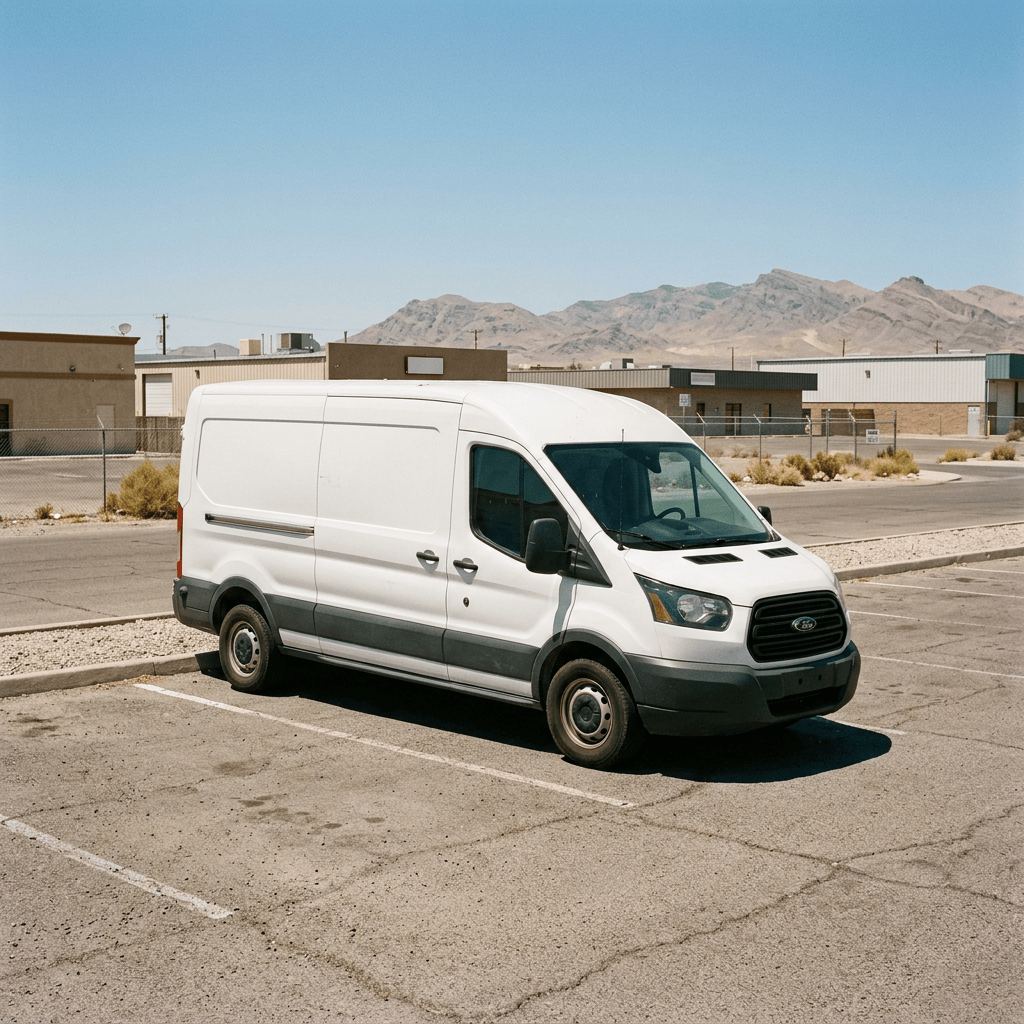
Short answer: Before you look at miles, confirm what the van is. Decode the VIN on NHTSA’s free decoder to see the model year, series (150, 250 or 350), roof height, drive type and weight class, and read the doorjamb label for that van’s carrying capacity. Then match the roof height and length to your job, check how the miles were put on, look hard at upfit and shelving damage, test the A/C front and rear (rear A/C is optional on the Transit Cargo Van, per Ford), confirm any tow package, and run the VIN for open recalls. This guide doesn’t quote prices. Condition and equipment vary on every used van, so see dealer for details.
Everything below comes from Ford’s own sources and NHTSA, checked October 20, 2026. It’s a used-van checklist, not a guide to ordering a new Transit.
In stock check: as of the afternoon of October 20, 2026, our used Transit Cargo Van page listed 0 vans. Used work vans come and go quickly, so contact us with the roof, length and series you need and we’ll watch for one, or browse all used inventory (93 listed the same day). If you’re open to new, our new Transit Cargo Van page listed 4.
Step 1: Decode the configuration from the VIN and the doorjamb
A Transit listing can say “cargo van” and leave out everything that matters. Two free checks fill the gaps:
- NHTSA’s VIN decoder (vpic.nhtsa.dot.gov/decoder). Enter the 17-character VIN. For a Transit, it typically shows the model year, the series (150, 250 or 350), the roof height, the body class (cargo van or passenger van), the drive type (RWD or AWD), a GVWR class and the engine size. We tested it on a Transit in our own inventory today and got all of those.
- The doorjamb label. Ford’s own guidance is to “see label on doorjamb for carrying capacity of a specific vehicle.” Payload and towing on a Transit change with series, roof, length, drive and equipment, so use the label on that van instead of any brochure number.
| What to confirm | Where to find it | Why it matters |
|---|---|---|
| Model year and series (150/250/350) | VIN decode | Series sets the weight ratings; Ford’s 2026 range runs from 8,670 to 11,000 lbs GVWR across Transit models |
| Roof height (Low/Medium/High) | VIN decode, then measure | Garage, parking-structure and driveway clearance; standing room |
| Length and wheelbase | Measure, or window sticker/build data | Parking, turning and how much floor you get |
| RWD or AWD | VIN decode, window sticker | Traction and how the van was specced |
| Engine | VIN decode, window sticker | Which 3.5L V6 it has (see Step 4) |
| Carrying capacity | Doorjamb label | The real payload for that van |
Step 2: Match roof height and length to the job
Ford builds the Transit in three roof heights and three lengths. On current vans, Ford lists these maximum cargo heights: about 52.8″ in the Low Roof, 67.6″ in the Medium Roof and 77″ in the High Roof. Older vans and different configurations can vary, so measure the van you’re looking at.
| Roof | Best fit for | Watch for |
|---|---|---|
| Low | Parking structures and low garages, ladder-rack setups, couriers | No standing room inside |
| Medium | Plumbing, HVAC and service calls where you work bent-over less | Taller than many residential garages; measure first |
| High | Stand-up workspace, tall cargo, shelving on both sides | Clearance at drive-thrus, garages and some job sites |
Current lengths, per ford.com: Regular 217.8″, Long 235.5″ and Extended 263.9″, on 130″ or 148″ wheelbases (Extended Length uses the 148″). Ford lists cargo-van volume behind the seats from 246.7 to 487.3 cu ft, depending on configuration.
In Las Vegas, the roof question usually comes down to where the van sleeps at night. HOA rules, home garages and covered parking at the shop decide more Transit purchases than cargo volume does. Measure your tightest clearance before you shop.
Step 3: Look at how the miles were put on
Two used Transits with the same odometer reading can be very different vans. Ask:
- What did it do? Parcel and delivery routes mean lots of stops, starts and idling. Trade vans often carry heavy shelving and tools every day. A shuttle or passenger use pattern is different again.
- Who maintained it? Fleet vans often have maintenance records. Ask for them, and ask whether the van was serviced on a schedule or only when something broke.
- How was it loaded? A van that lived near its maximum carrying capacity works its brakes, suspension and tires harder. Look for uneven tire wear, sagging at the rear and worn brake components.
- How many drivers? Interior wear on the driver’s seat, steering wheel and door panels tells you how hard the cab was used.
We won’t give you a “good mileage” cutoff. Use the records, the inspection and the use history together.
Step 4: Engine and drive by model year
Recent Transit cargo vans use one of two 3.5L V6 gas engines, both with a 10-speed automatic, per Ford:
| Engine | Ford’s current rating | Used-van note |
|---|---|---|
| 3.5L PFDi V6 | 275 hp, 260 lb-ft | Ford’s 2026 order guide says Flex Fuel capability was removed from this engine for 2026, so don’t assume an older van and a 2026 van are set up the same |
| 3.5L EcoBoost V6 | 300 hp, 400 lb-ft | Per Ford’s 2024 order guide, it wasn’t available on low- and medium-roof RWD Cargo Vans for 2024 (except with the Ambulance Prep Package); Ford’s 2026 guide says it’s available on those vans again |
A few more model-year details from Ford’s order guides:
- 2024: Ford removed Auto Start-Stop from both 3.5L engines.
- AWD: Ford offers Intelligent AWD on current Transits and says it doesn’t change the load floor or seat height. Confirm drive type on the VIN decode; don’t rely on badging.
- Older vans: earlier Transits may have different engines and transmissions. Read the engine and transmission off the VIN decode or window sticker for the van you’re buying.
This guide covers gas Transit vans. If you’re looking at a used E-Transit, ask us separately; battery and charging questions deserve their own checklist.
Step 5: Inspect the upfit, shelving and cargo area
Most used Transits have been upfitted. Upfits add value when they match your work and cost you time when they don’t.
- Shelving and bins: are they secured, and do you want them? Removing shelving can leave holes in the floor or walls. Look for rust, sealant and patched holes around every mount.
- Bulkhead/partition: Ford offers bulkhead options from the factory. If there’s one, check that it’s secure and that any door in it latches.
- Roof racks and ladder racks: look at the mounting points and roof seals, and check for water stains inside.
- Added wiring: inverters, lights and strobes added by an upfitter should be fused and neatly routed. Ask who installed them.
- Floor and wall liners: lift the floor covering if you can. Spilled fluids and water can hide under it.
- Doors: open and close the sliding side door and both rear doors fully. Hinges and latches on a work van get a lot of use.
Step 6: Las Vegas heat checks
A Transit cargo area gets hot in a Las Vegas summer. Check these before you buy:
- Rear A/C. Per Ford’s 2026 order guide, A/C on the Transit Cargo Van is front-only as standard, and Front/Rear Auxiliary A/C and Heater is an option. If your crew rides in back or your cargo is heat-sensitive, confirm whether the van you’re looking at has it, then test it cold.
- Front A/C at idle. Let the van idle with the A/C on for several minutes. Delivery vans spend a lot of time stopped.
- Tires. Check tread and the date code on every tire, including the spare if the van has one. Sun and heat age rubber.
- Battery and charging. Ask how old the battery is, especially if the van ran added electrical equipment.
- Seals and dash. Look for cracked door seals and a sun-damaged dash or screen.
Step 7: Towing, records and recalls
- Towing. Ford lists up to 6,900 lbs of max conventional towing for current Transit vans, when properly equipped, and a Heavy-Duty Trailer Tow Package. A used van’s rating depends on its configuration and equipment. Check for a factory hitch and wiring, and use the doorjamb label and owner’s manual for that van.
- Records. Ask for service records and any fleet maintenance history.
- Recalls. Run the VIN on NHTSA.gov/recalls or Ford’s recall lookup. Per Ford, recall parts and service are free through a Ford dealer. Our service department can take care of open recalls, and you can schedule service online.
Used, or new?
If you can’t find the right used configuration, a new Transit may get you there faster. Our live Ford Transit Cargo Van guide walks through choosing a new van by trade, and our Section 179 guide explains the tax rule in plain English (talk to your tax professional about your business). We’re also finishing a used Super Duty and Transit “work-ready” checklist for crews buying more than one vehicle.
Frequently Asked Questions
What should I check first on a used Ford Transit?
Confirm the configuration. Decode the VIN on NHTSA’s free decoder to see the model year, series, roof height, drive type and weight class, and read the doorjamb label for that van’s carrying capacity. Then inspect the miles, upfit, A/C, towing equipment and recalls.
Which used Transit roof height do I need?
It depends on where the van parks and how you work inside it. Per Ford, current vans offer about 52.8 inches of maximum cargo height in the Low Roof, 67.6 in the Medium Roof and 77 in the High Roof. Measure your garage or parking clearance before you shop.
What’s the difference between a Transit 150, 250 and 350?
They’re weight series. The series sets the van’s weight ratings (Ford’s 2026 GVWR range runs from 8,670 to 11,000 lbs across Transit models). Check the doorjamb label for the actual carrying capacity of the van you’re looking at.
Do used Transit cargo vans have rear A/C?
Not always. Per Ford’s 2026 order guide, A/C on the Transit Cargo Van is front-only as standard, and front/rear auxiliary A/C and heater is an option. Check the van you’re considering and test it.
Is a high-mileage used Transit a bad buy?
Not automatically. How the miles were put on (route type, loads, maintenance records) matters as much as the number. Use the records and an inspection together.
Does Team Ford Las Vegas have used Transit vans in stock?
As of October 20, 2026, our used Transit Cargo Van page listed 0 vans and our new Transit Cargo Van page listed 4. Stock changes often; contact us and we’ll watch for the configuration you need.
Conclusion + next steps
Buy the configuration first and the van second. Decode it, read the label, measure your clearance, then let the records, the upfit and the A/C decide between two vans that look alike.
Team Ford Las Vegas, 5445 Drexel Rd, Las Vegas, NV 89130. Closed Sundays. Specs per Ford as of October 20, 2026; ratings and equipment vary by configuration and model year. See dealer for details.
{ “@context”: “https://schema.org”, “@type”: “BlogPosting”, “headline”: “Buying a Used Ford Transit in Las Vegas: Roof, Length and Mileage Checklist for Small Businesses”, “description”: “Buying a used Ford Transit cargo van in Las Vegas? Decode roof, length and series from the VIN, then check miles, upfits, rear A/C, towing and recalls. No prices.”, “url”: “https://www.teamfordlasvegas.com/blog/used-ford-transit-buying-guide-las-vegas/”, “datePublished”: “2026-10-20”, “dateModified”: “2026-10-20”, “author”: {“@type”: “Organization”, “name”: “Team Ford Las Vegas”}, “publisher”: { “@type”: “AutoDealer”, “name”: “Team Ford Las Vegas”, “url”: “https://www.teamfordlasvegas.com/”, “address”: {“@type”: “PostalAddress”, “streetAddress”: “5445 Drexel Rd”, “addressLocality”: “Las Vegas”, “addressRegion”: “NV”, “postalCode”: “89130”, “addressCountry”: “US”} }, “mainEntityOfPage”: “https://www.teamfordlasvegas.com/blog/used-ford-transit-buying-guide-las-vegas/”, “about”: {“@type”: “Vehicle”, “name”: “Used Ford Transit Cargo Van”, “brand”: {“@type”: “Brand”, “name”: “Ford”}, “model”: “Transit”}, “citation”: [“https://www.ford.com/trucks/transit-passenger-van-wagon/”, “https://www.fromtheroad.ford.com/us/en/articles/2026/whats-new-2026-ford-transit”, “https://vpic.nhtsa.dot.gov/decoder/”, “https://www.nhtsa.gov/recalls”, “https://www.ford.com/support/recalls-details/”%5D } { “@context”: “https://schema.org”, “@type”: “FAQPage”, “mainEntity”: [ {“@type”: “Question”, “name”: “What should I check first on a used Ford Transit?”, “acceptedAnswer”: {“@type”: “Answer”, “text”: “Confirm the configuration. Decode the VIN on NHTSA’s free decoder to see the model year, series, roof height, drive type and weight class, and read the doorjamb label for that van’s carrying capacity. Then inspect the miles, upfit, A/C, towing equipment and recalls.”}}, {“@type”: “Question”, “name”: “Which used Transit roof height do I need?”, “acceptedAnswer”: {“@type”: “Answer”, “text”: “It depends on where the van parks and how you work inside it. Per Ford, current vans offer about 52.8 inches of maximum cargo height in the Low Roof, 67.6 in the Medium Roof and 77 in the High Roof. Measure your garage or parking clearance before you shop.”}}, {“@type”: “Question”, “name”: “What’s the difference between a Transit 150, 250 and 350?”, “acceptedAnswer”: {“@type”: “Answer”, “text”: “They’re weight series. The series sets the van’s weight ratings (Ford’s 2026 GVWR range runs from 8,670 to 11,000 lbs across Transit models). Check the doorjamb label for the actual carrying capacity of the van you’re looking at.”}}, {“@type”: “Question”, “name”: “Do used Transit cargo vans have rear A/C?”, “acceptedAnswer”: {“@type”: “Answer”, “text”: “Not always. Per Ford’s 2026 order guide, A/C on the Transit Cargo Van is front-only as standard, and front/rear auxiliary A/C and heater is an option. Check the van you’re considering and test it.”}}, {“@type”: “Question”, “name”: “Is a high-mileage used Transit a bad buy?”, “acceptedAnswer”: {“@type”: “Answer”, “text”: “Not automatically. How the miles were put on (route type, loads, maintenance records) matters as much as the number. Use the records and an inspection together.”}}, {“@type”: “Question”, “name”: “Does Team Ford Las Vegas have used Transit vans in stock?”, “acceptedAnswer”: {“@type”: “Answer”, “text”: “As of October 20, 2026, the used Transit Cargo Van page listed 0 vans and the new Transit Cargo Van page listed 4. Stock changes often; contact Team Ford to watch for the configuration you need.”}} ] }

Response
[…] when you talk to us so the roof, length and options match the build. For the used side, see our used Ford Transit buying checklist. We had no used Transit cargo vans listed on November […]
LikeLike